MEMS vs. Piezoelectric Sensors
MEMS and piezoelectric accelerometers each have their place in vibration monitoring. Piezo sensors offer superior sensitivity and frequency range for high-precision analysis, while modern MEMS sensors provide stability, wide temperature tolerance, and low cost—ideal for scalable, continuous monitoring. The real choice depends on whether the goal is maximum accuracy for critical assets or practical visibility across the entire plant.
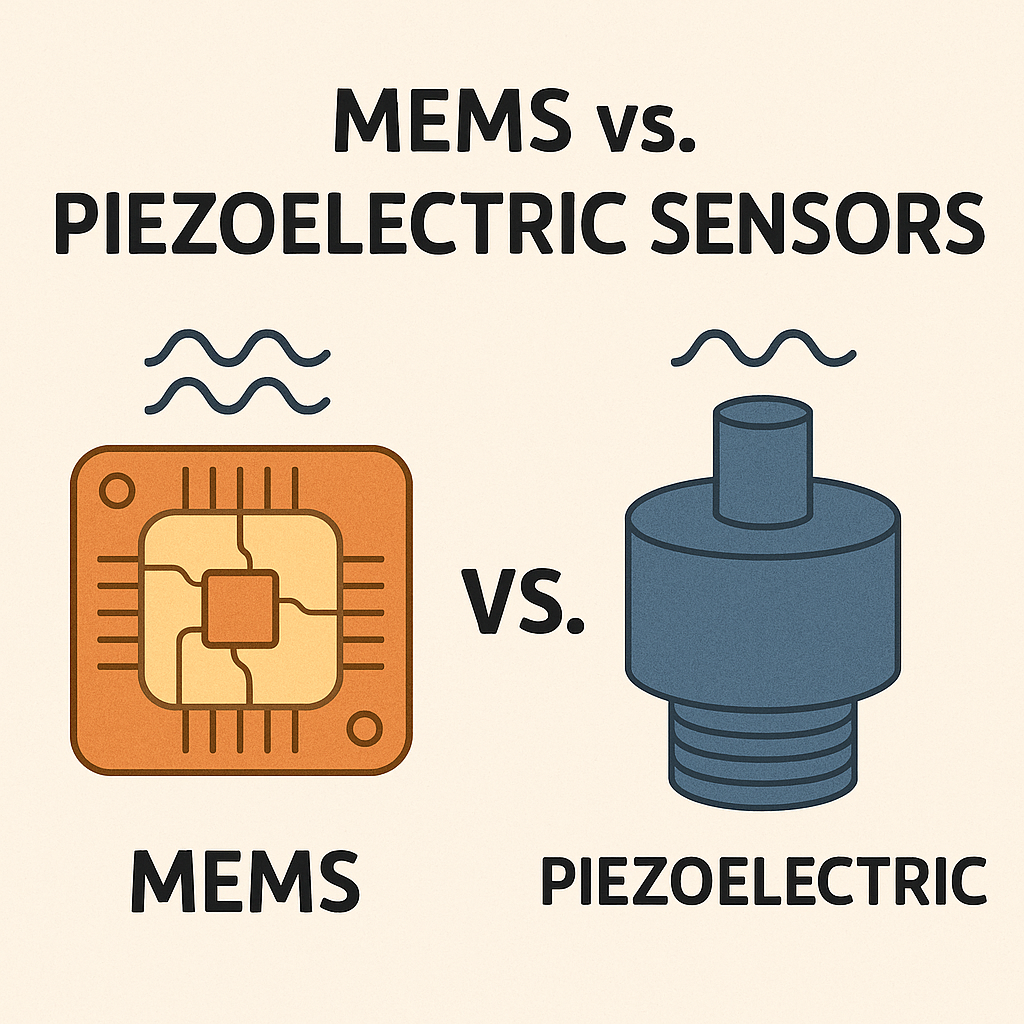
In vibration monitoring, one of the hottest debates today is the use of MEMS accelerometers vs. traditional piezoelectric accelerometers. Both technologies have their strengths, and both are widely used in condition monitoring—but the choice often depends on the application, the environment, and the budget.
Piezoelectric accelerometers have long been considered the gold standard in industrial monitoring. They provide excellent sensitivity, wide frequency response, and proven reliability in harsh conditions. For years, if you wanted “serious” vibration data, you went with piezo. But they also come with limitations: they are more expensive, require regular calibration (often yearly), and can be more sensitive to environmental factors like temperature drift.
MEMS accelerometers, on the other hand, were once seen as “consumer-grade” devices, mainly for phones and wearables. But in the last decade, MEMS technology has advanced significantly. Today’s high-end MEMS sensors are stable, accurate, and rugged enough for industrial applications. They typically don’t require yearly calibration, they perform well across a wide temperature range, and they are cost-effective—making it feasible to monitor many more assets, not just the most critical ones.
Of course, MEMS still has some limitations. Their upper frequency range is generally lower than piezo sensors, which can matter for detecting very high-frequency faults like certain bearing defects. But in many industrial assets—motors, pumps, fans, compressors—the frequency range of MEMS is more than sufficient. And the trade-off often means more machines can be monitored continuously at a lower cost.
That brings us to the key question: do we really need every sensor to be “lab-grade,” or do we need a practical, scalable solution that gives us visibility across the plant? Many failures are detectable well within the range of MEMS, and with no yearly calibration needed, the total cost of ownership is far lower.