Low-Frequency Response: Piezoelectric vs MEMS Vibration Sensors
MEMS accelerometers outperform piezoelectric sensors in low-frequency applications due to their stable response and ability to measure static acceleration. This makes them ideal for slow-speed machinery, structural motion analysis, and early fault detection.
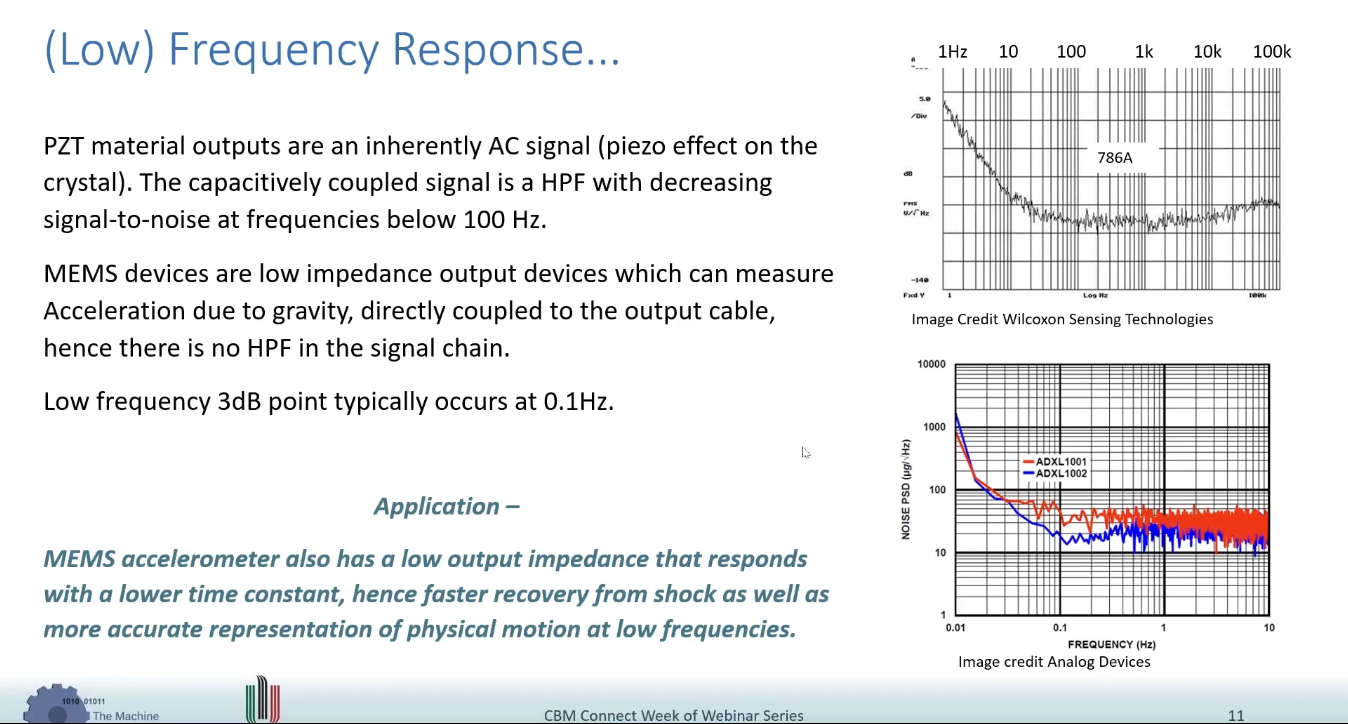
Understanding sensor behavior at low frequencies is critical for reliable condition monitoring, especially for slow-speed machines, structural motion, and early fault detection.
This post is inspired by insights and graphs shared during the webinar:
“POST-MEMS Accelerometers – Technology Review and Implications for CBM”
by Ed Spence & Adam Jablonski (CBM Live Webinar Series).
(Webinar link referenced for further reading.)
⸻
🔹 First, a simple definition
Piezoelectric (PZT) accelerometers
• Generate an electrical charge when the crystal is mechanically stressed
• Output signal is inherently AC
• Require capacitive coupling, which introduces a high-pass filter (HPF) in the signal chain
MEMS accelerometers
• Use micro-machined structures with integrated electronics
• Provide low-impedance, directly coupled outputs
• Can measure static acceleration (including gravity)
⸻
🔬 Low-Frequency Behavior Explained
Piezoelectric (PZT) sensors
• Capacitively coupled → behave like a high-pass system
• Signal-to-noise ratio degrades rapidly below ~100 Hz
• Very limited sensitivity at low frequencies
• Not suitable for true DC or near-DC measurements
MEMS sensors
• No HPF in the signal chain
• Low-frequency –3 dB point typically around 0.1 Hz
• Stable response down to very low frequencies
• Capable of capturing slow motion, tilt, and low-speed vibration
The difference is clearly visible in the referenced graphs:
👉 MEMS maintains usable noise performance at low frequencies, while PZT rolls off sharply.
⸻
⚙️ Application Insight
Because of their low output impedance and lower time constant, MEMS accelerometers:
• Recover faster from mechanical shock
• Provide more accurate representation of physical motion at low frequencies
• Are better suited for:
• Slow-speed rotating machinery
• Large structures and foundations
• Early-stage fault detection
• Low-frequency vibration and motion analysis
⸻
✅ Key Takeaway
Based on both sensor physics and measured frequency response,
MEMS accelerometers show a clear advantage over piezoelectric sensors in low-frequency applications, as demonstrated in the referenced webinar material.
Both technologies have their place—but when low-frequency accuracy matters, MEMS is the more appropriate choice.
Reference: https://mobiusinstitute.vids.io/videos/ac9ddcb01e17ecc225/cbm_live-webinar-post_mems-accelerometers-technology-review-and-implications-for-cbm-by-ed-spence-adam-jablonski-mp4
MEMS Accelerometers – Technology Review and Implications for CBM by Ed Spence & Adam Jablonski