Why MEMS Accelerometers Need Far Less Recalibration Than Piezoelectric Sensors
MEMS accelerometers, made from silicon, offer greater stability and reduced recalibration needs compared to piezoelectric accelerometers. Their inherent stability, precise manufacturing, and built-in diagnostics make them ideal for industrial vibration monitoring and machine-health solutions.

Introduction: MEMS, Accelerometers, and Calibration
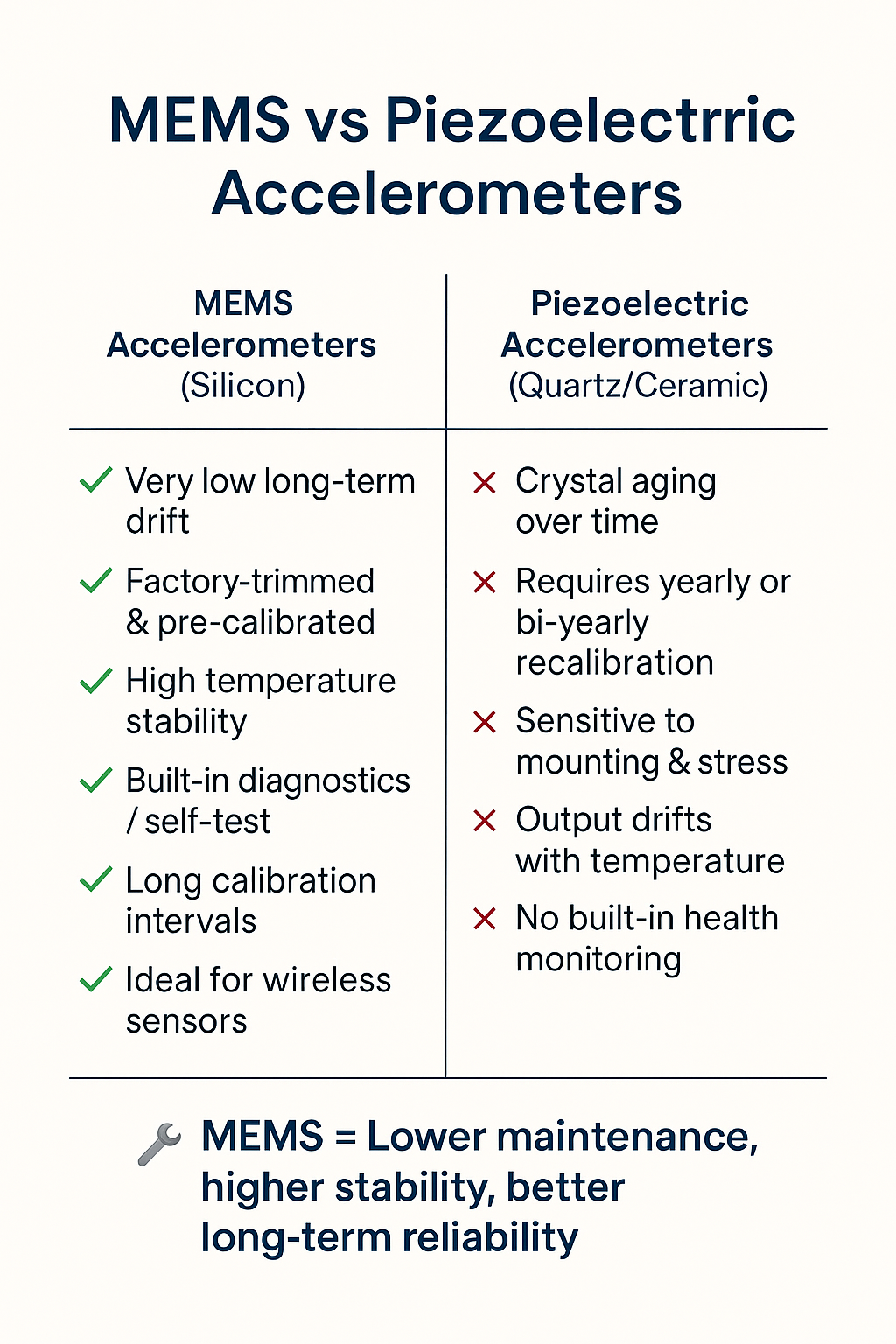
Accelerometers are at the core of vibration measurement and machine-health monitoring. Traditionally, piezoelectric accelerometers have been used, but they often require recalibration every 12–24 months due to drift in their crystal materials.
MEMS (Micro-Electro-Mechanical Systems) accelerometers, however, are built from silicon using semiconductor processes—offering far greater stability and reducing the need for frequent recalibration.
Calibration ensures a sensor continues to measure accurately over time. When a sensing element drifts, calibration becomes necessary. The key difference between piezoelectric and MEMS accelerometers lies in how stable the sensing mechanism remains over years of operation.
Why MEMS Require Much Less Recalibration
1. Silicon is inherently stable
MEMS accelerometers use silicon structures that do not suffer from the aging, charge drift, or stress relaxation seen in piezoelectric crystals. Their mechanical properties remain consistent over time, temperature, and voltage.
2. Semiconductor manufacturing ensures tight tolerances
MEMS devices are produced with microfabrication techniques used in the semiconductor industry. Processes like laser trimming and wafer-level tuning provide highly consistent sensing elements that leave the factory already calibrated.
3. Minimal long-term drift
MEMS structures are sealed, inert, and resistant to contamination and environmental effects. Unlike piezoelectric crystals, they do not gradually change their output as they age.
4. Built-in self-diagnostics
Modern MEMS accelerometers include internal self-test features that monitor the health of the sensing element and compensate for slight changes automatically—reducing the need for external recalibration.
5. High temperature stability
MEMS accelerometers maintain accuracy across wide temperature ranges, making them suitable for harsh industrial environments with minimal performance shift.
While proper PCB placement, enclosure design, and time-base accuracy remain important, the core sensing element in MEMS technology is far more stable than its piezoelectric counterpart.
Conclusion
MEMS accelerometers have matured into a highly reliable technology for industrial vibration monitoring. Their silicon-based construction, precise manufacturing, and built-in diagnostics drastically reduce the need for periodic recalibration—unlike piezoelectric sensors, which naturally drift over time.
This makes MEMS the ideal choice for wireless sensors, remote systems, and applications where recalibration is difficult or expensive.
In modern condition monitoring, MEMS delivers long-term stability, lower maintenance, and dependable performance—a clear advantage for next-generation machine-health solutions.
Reference: Alan McCall, "MEMS Accelerometers and Yearly Calibration", cbmconnect, June 2023
Additional Images