MEMS vs. Quartz Oscillators: Why Aging Performance Is Redefining Precision Timing
MEMS oscillators, manufactured using semiconductor processes, offer superior aging performance compared to quartz oscillators. MEMS oscillators exhibit minimal drift, consistent behavior across units, and are less sensitive to environmental stressors, making them ideal for high-precision applications requiring long-term stability. As a result, MEMS oscillators are becoming the preferred choice for designers seeking tighter specifications and higher system reliability.
From industrial automation to telecommunications, modern electronics rely on precise timing. Every system that measures, synchronizes, or communicates depends on a stable clock source known as an oscillator. These oscillators generate a highly accurate periodic signal, forming the heartbeat of electronic systems—whether inside smartphones, servers, satellites, or mission-critical industrial networks.
Two dominant oscillator technologies exist today:
• Quartz (Piezoelectric) Oscillators
These have been the long-standing standard of timing. A quartz crystal resonates mechanically when voltage is applied, and this resonance—governed by the piezoelectric effect—produces a highly stable frequency.
• Silicon MEMS Oscillators (Micro-Electro-Mechanical Systems)
A newer approach where tiny silicon structures are engineered to vibrate at precise frequencies. Manufactured using semiconductor processes, MEMS oscillators offer advantages in robustness, programmability, and environmental resilience.
While both serve the same purpose, their long-term frequency stability—especially aging performance—differs dramatically. And in high-precision applications, that difference matters.
Why Aging Matters in Timing Systems
“Aging” describes how an oscillator’s output frequency slowly shifts over time due to internal material changes. Even extremely small drifts—measured in parts per million (ppm) or parts per billion (ppb)—can accumulate into real-world errors, such as:
• Network desynchronization
• Positioning inaccuracies
• Clock drift during GPS signal loss
• Reduced accuracy in industrial measurement devices
• Failures in high-reliability systems requiring long-term holdover
Applications like telecom base stations, measurement instruments, data centers, industrial automation systems, and aerospace platforms rely on oscillators that remain stable for hours, days, or years, especially during holdover—when no external timing reference (e.g., GPS) is available.
This is where aging plays a decisive role.
Aging Mechanisms: Quartz vs. MEMS
Quartz (Piezoelectric) Aging: A Materials Problem
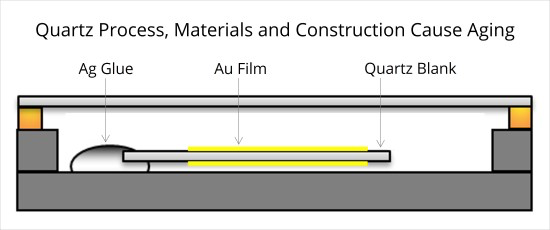
Quartz resonators are grown, cut, polished, bonded, and packaged in processes involving multiple mechanical and chemical steps. These steps introduce:
• Surface micro-cracks and polishing abrasion
• Residual internal stress between the crystal and electrodes
• Thermal expansion mismatch between materials
• Outgassing and contamination, especially from adhesives and packaging
• Mass loading effects that alter the resonant frequency over time
• Stress relaxation causing gradual frequency drift
These physical changes accumulate inside the resonator structure and are irreversible. The result is noticeable long-term drift, often nonlinear and variable between devices.
Even high-performance quartz devices like OCXOs (oven-controlled oscillators) show:
• Higher initial aging
• Significant device-to-device variability
• Drift that can accelerate negatively over weeks or months
• Sensitivity to environmental stressors (shock, vibration, temperature cycles)
MEMS Aging: A Semiconductor Advantage
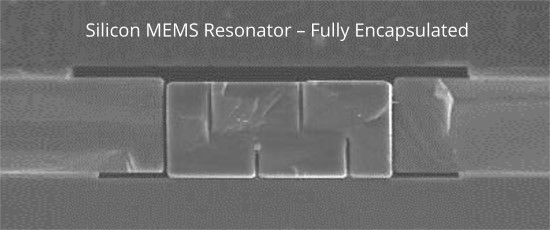
MEMS resonators operate on silicon—a highly stable, non-outgassing, non-porous material with predictable mechanical properties. Crucially, advanced MEMS manufacturing processes (such as SiTime’s EpiSeal® technology) encapsulate resonators:
• In clean, high-temperature (>1000 °C) vacuum environments
• With no adhesives, no organic materials, and no polishing contamination
• Using wafer-scale processing with atomic-level lattice stability
This results in:
• Virtually no internal contamination
• Minimal stress relaxation
• Extremely low drift over time
• Consistent behavior across units, thanks to semiconductor-level repeatability
• Fast stabilization after initial power-on
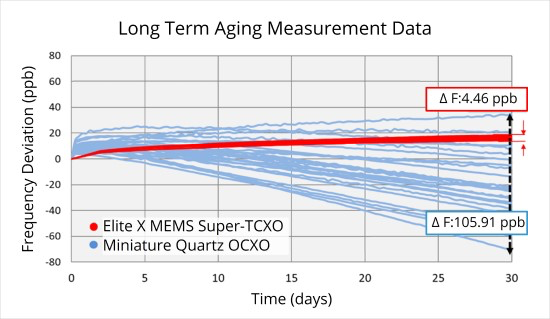
Where quartz devices can drift tens to hundreds of ppb, MEMS devices often maintain offsets below 20 ppb over 30 days—even compared to miniaturized OCXOs designed for Stratum-3E precision.
Direct Comparison of Aging Performance
1. Initial Aging Behavior
Quartz OCXOs typically show positive aging initially but shift significantly over time. Many devices eventually exhibit negative aging slopes, drifting in the opposite direction.
MEMS oscillators stabilize rapidly, reaching a low drift state within days.
2. Long-Term Drift Stability
• Quartz oscillators:
Drift can continue for weeks or months, often nonlinear and unpredictable.
• MEMS oscillators:
Drift becomes almost flat after stabilization, remaining within very tight bounds.
3. Device-to-Device Variability
Quartz aging varies widely depending on manufacturing imperfections.
MEMS variability is extremely small due to microfabrication precision.
4. Sensitivity to Environment
Quartz aging is accelerated by temperature, humidity, shock, and vibration.
Silicon MEMS structures are inherently more robust and immune to outgassing and mass-loading effects.
5. Impact on Holdover
In systems where GPS or external timing is lost:
• Quartz oscillators accumulate significant drift over hours or days.
• MEMS oscillators maintain far better timing accuracy, enabling stable holdover performance.
⸻
Conclusion: MEMS Aging Performance Sets a New Standard
Aging is inevitable for all oscillators—but its magnitude and predictability differ sharply between quartz and MEMS. Quartz’s mechanical manufacturing process introduces stress, contamination, and long-term instabilities that lead to significant frequency drift. MEMS oscillators, designed and built through advanced semiconductor processes, avoid these weaknesses and deliver order-of-magnitude better aging stability.
As industrial systems, telecom infrastructure, autonomous machines, and precise measurement platforms demand increasingly reliable timing—even during outages—MEMS oscillators provide a cleaner, more stable, and more predictable long-term frequency reference.
For designers seeking tighter specifications, lower drift, and higher system reliability, MEMS-based timing solutions are rapidly becoming the superior choice—redefining what “precision timing” means for the next generation of technology.
Reference: "Aging in OCXO and TCXO", SiTime Corporation, White Paper, October 2022, www.sitime.com
Additional Images