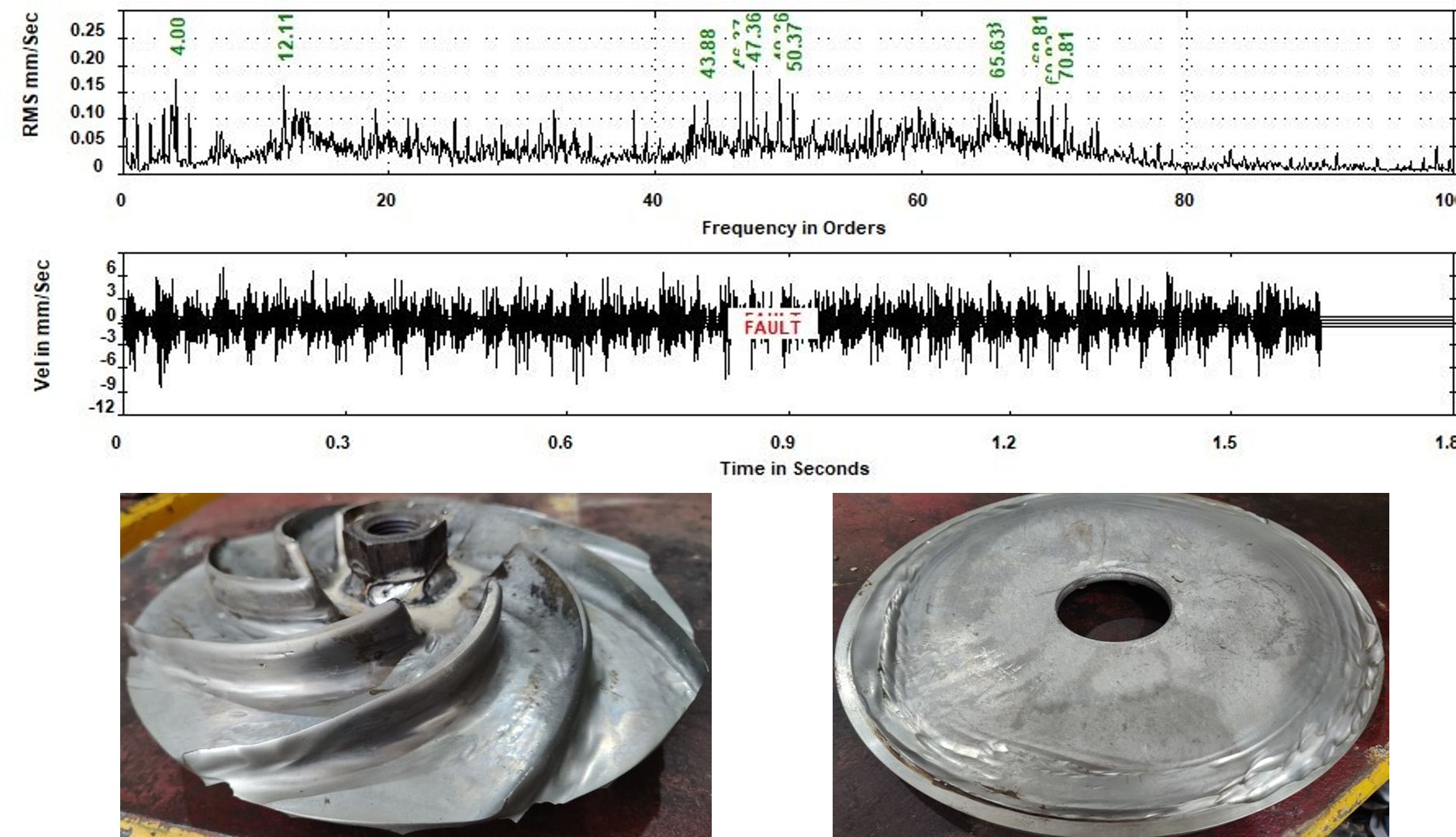
Pump Cavitation Case Study
Cavitation, caused by low pressure in a pump, leads to bubble formation, collapse, and erosion. It can be identified in vibration spectra by high-frequency peaks, raised noise floors, and impacting signs.
Cavitation occurs when the “NPSH available” falls below the “NPSH required” for a pump (i.e. liquid's pressure drops below its vapor pressure). This low pressure causes bubbles to form in a liquid, which then collapse violently & generate intense shockwaves, leading to erosion of nearby surfaces and producing noise. It can also induce damaging oscillations within pump, contributing to premature wear and tear of internals (i.e. impeller, partition plate & volute casing), decreased efficiency, and potentially catastrophic failure if left unchecked.
In the vibration spectrum, the presence of cavitation induced vibrations can be identified by observing hump at higher frequency peaks with raised noise floor. These peaks may also appear at frequencies corresponding to blade passing frequencies or other characteristic frequencies of the rotating components. In waveform analysis, impacting signs with random burst of energy will be observed. Additionally if you listen to vibration, it will appear like gravel in the pump.
Additional Images