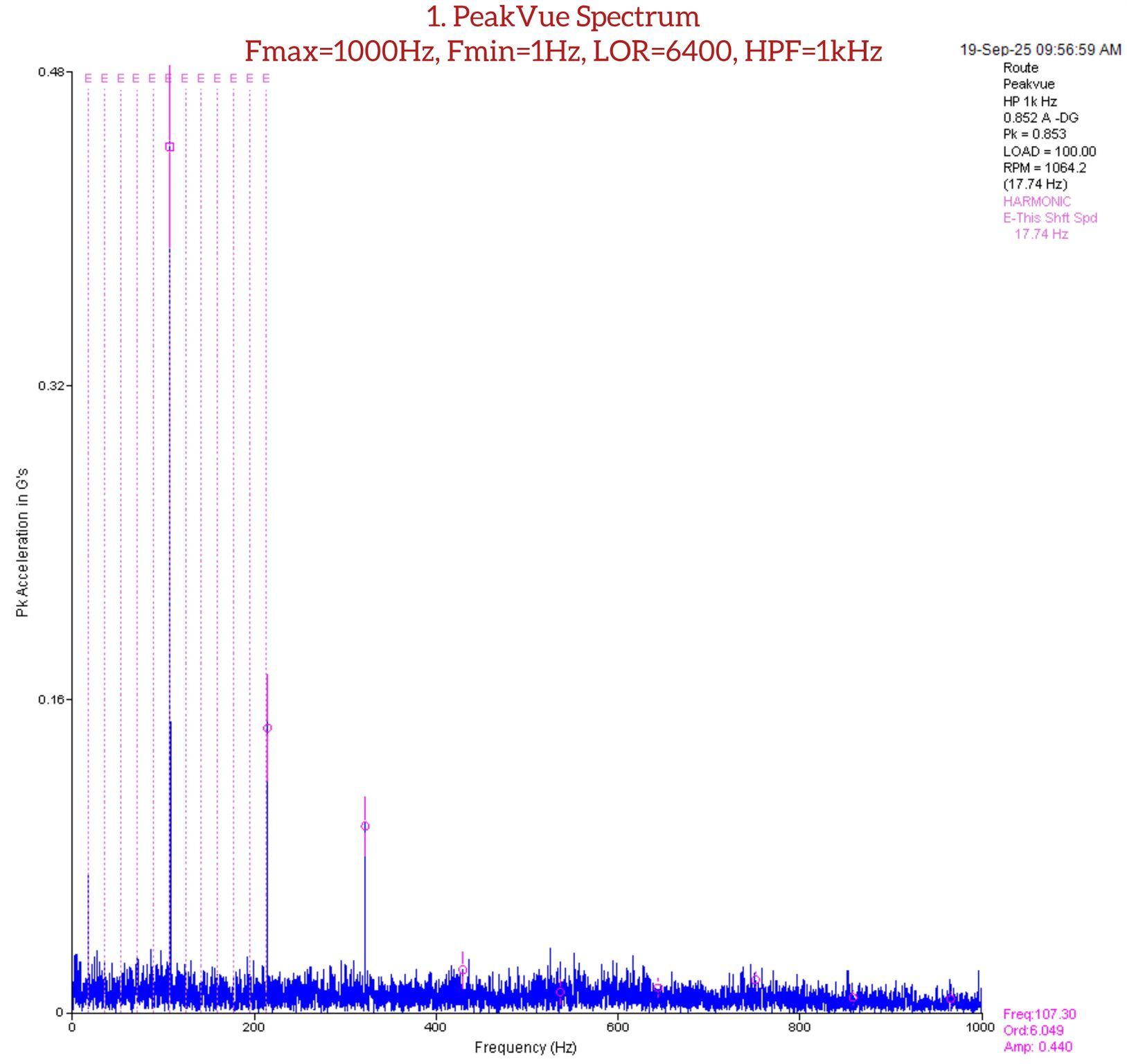
Line Frequency Harmonics of VFD-Driven Motor in Peakvue Spectra
PeakVue spectra reveal 2× line frequency harmonics in VFD-driven motors due to electromagnetic forces exciting high-frequency stress waves. These waves, modulated at 2× line frequency, pass through the high-pass filter and are extracted during demodulation, explaining their presence in the spectrum.
𝐖𝐡𝐲 𝐝𝐨 𝐰𝐞 𝐬𝐞𝐞 𝟐× 𝐋𝐢𝐧𝐞 𝐅𝐫𝐞𝐪𝐮𝐞𝐧𝐜𝐲 𝐢𝐧 𝐏𝐞𝐚𝐤𝐕𝐮𝐞 𝐒𝐩𝐞𝐜𝐭𝐫𝐮𝐦 𝐞𝐯𝐞𝐧 𝐰𝐢𝐭𝐡 𝐚 𝐇𝐢𝐠𝐡-𝐏𝐚𝐬𝐬 𝐅𝐢𝐥𝐭𝐞𝐫?
While analyzing a VFD-driven motor, I captured two spectra:
📊 1. PeakVue Spectrum (HPF = 1 kHz, up to 1 kHz Fmax) – surprisingly reveals harmonics at 2× line frequency (VFD Line Frequency).
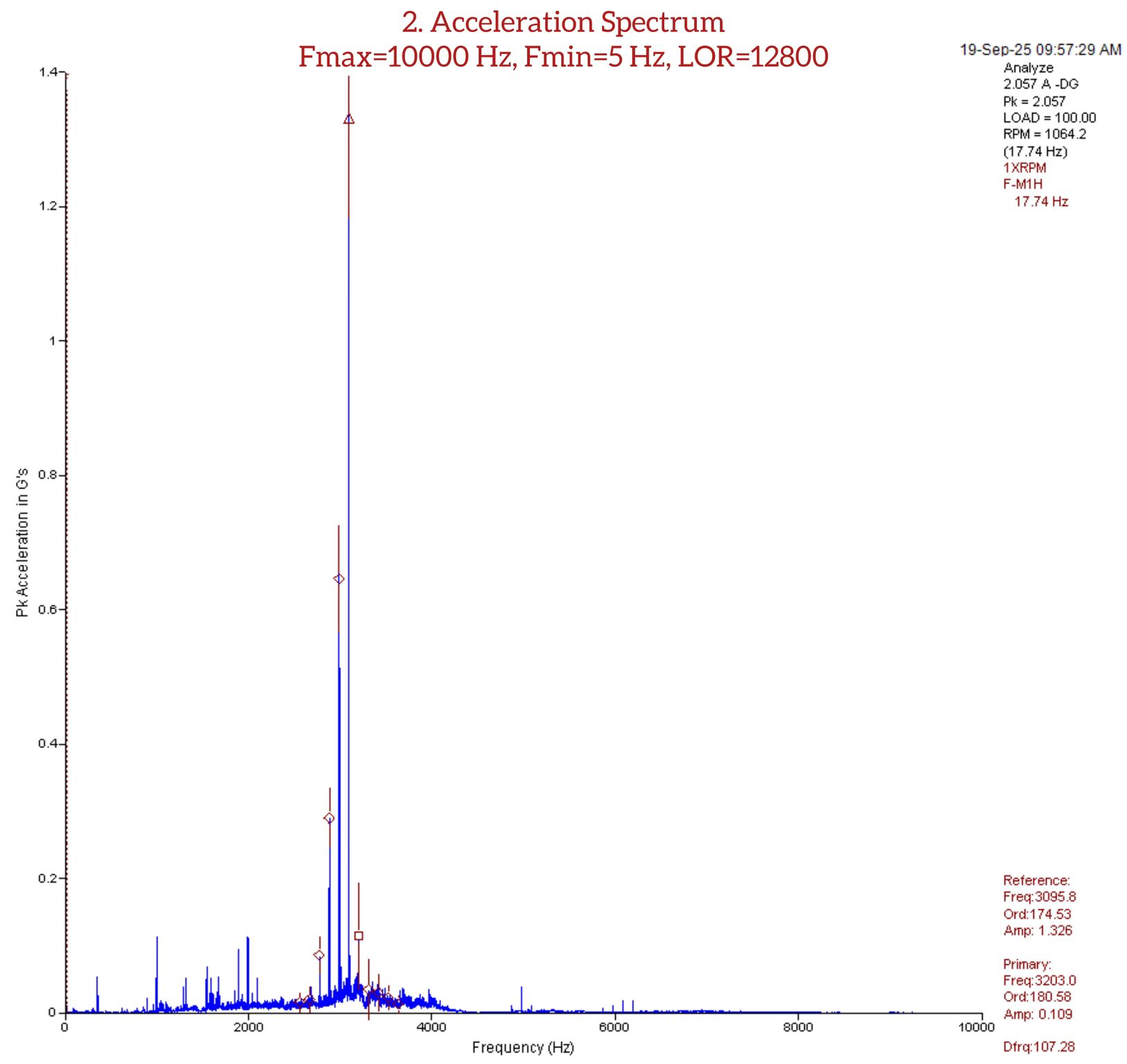
📊 2. Acceleration Spectrum (up to 10 kHz) – showing strong activity around 3,200 Hz. Reveals sidebands (modulation) of 107.2 Hz.
This often raises a key question:
If PeakVue applies a 1 kHz high-pass filter, why do we still see 2× line frequency (2x VFD line frequency) in the demodulated spectrum?
Here’s why:
⚡ Electromagnetic Forces – VFDs create magnetic pull forces in motors, dominant at 2× line frequency.
🎯 Stress Wave Excitation – These forces excite high-frequency stress waves (>1 kHz) in the bearing/structure.
🎚️ Filtering & Demodulation – The high-frequency content passes through PeakVue’s filter. During demodulation, the low-frequency modulation (2× line freq) is extracted, so it shows up in the PeakVue spectrum.
✅ That’s why we observe a clear 2× line frequency harmonic even though low frequencies were filtered out.
💡 Key takeaway:
PeakVue isn’t showing the “direct” 2× LF vibration — it’s revealing modulated high-frequency stress waves excited by electromagnetic forces.
This is why interpreting PeakVue requires understanding both the mechanical and electrical excitation mechanisms in VFD-driven machines.
📌 Have you come across similar findings in your vibration/CBM analysis with VFD-driven motors? How did you interpret them? Is it too often to see these patterns in VFD motors?
Additional Images