Footbridges – Assessment of Comfort Classes
Footbridge design must consider human-induced vibrations, including pedestrian traffic, lock-in phenomenon, and intentional excitation. Vibration monitoring of the Elwood footbridge assessed comfort levels and natural frequencies through various excitation tests.

The increase of vibration problems in modern footbridges shows that footbridges should no longer be designed for static loads only. The dynamic response is determined by natural frequencies, damping properties, bridge mass and pedestrian loading. Footbridges should be designed in such a way that this pedestrian-bridge-interaction phenomenon, also called ‘lock-in’, does not arise. Another dynamic load on footbridges is intentional excitation by people that are jumping on the spot, bouncing, swaying body horizontally, shaking stay cables etc. at resonance frequency to produce large vibrations.
Hence, in footbridge design, the assessment of human-induced vibrations needs to be considered by the designer to ensure that:
🔸 Vibrations due to pedestrian traffic is acceptable for the users,
🔸 The lock-in phenomenon does not arise,
🔸 The footbridge does not collapse when subjected to intentional excitation.
If a footbridge is susceptible to vibrations that might affect the human comfort, measurement procedures for evaluation of dynamic properties should be required.
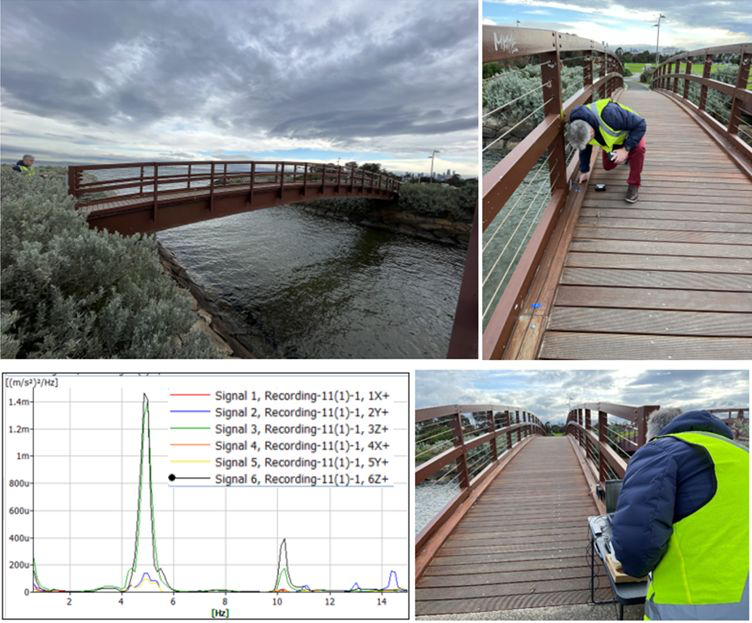
Our Team conducted vibration monitoring of the Elwood footbridge to confirm the degree of comfort level and natural frequencies due to ambient responses. Testing involved excitation of walking, running and jumping on the bridge to evaluate the maximum transient vibration value and power spectral density of the structural accelerations in the mid-span and other critical locations.
Sensors were located on strategic locations at the timber floor deck and steel structure. Below, a picture of the footbridge and the typical configuration of the accelerometers. Thanks Thomas Lee and Iván Muñoz Díaz.
Additional Images