Chiller Pump Bearing Failure Due to Cavitation
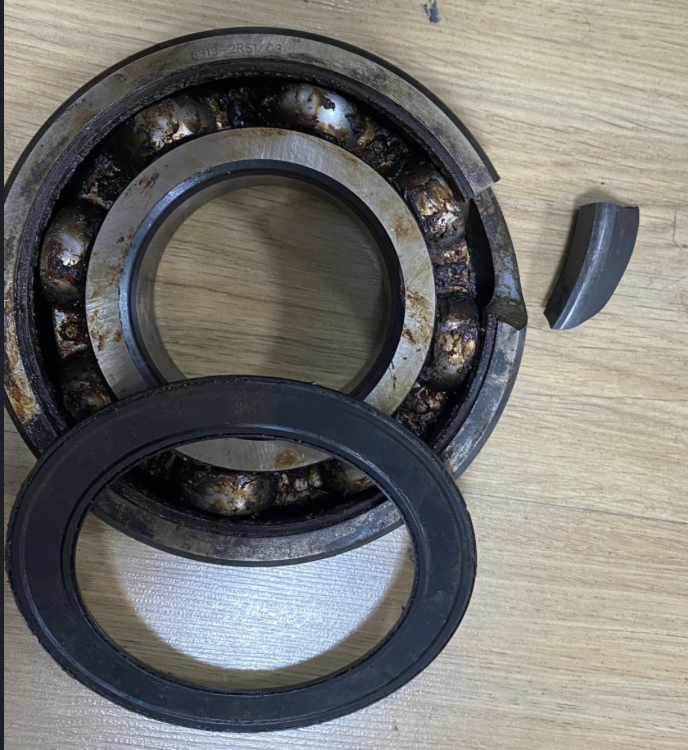
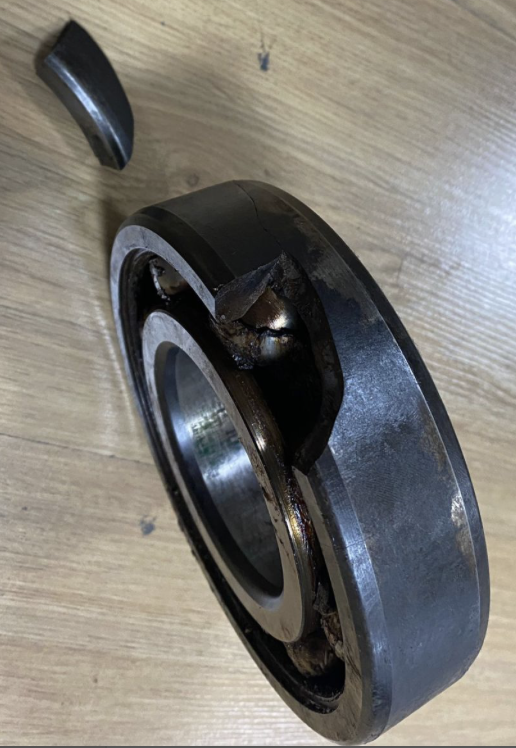
A chiller pump experienced a bearing failure due to cavitation, likely caused by water leakage into the bearing housing. This led to damage to the seal and mechanical seal, allowing water to seep in.
Bearing Fault Case Study:
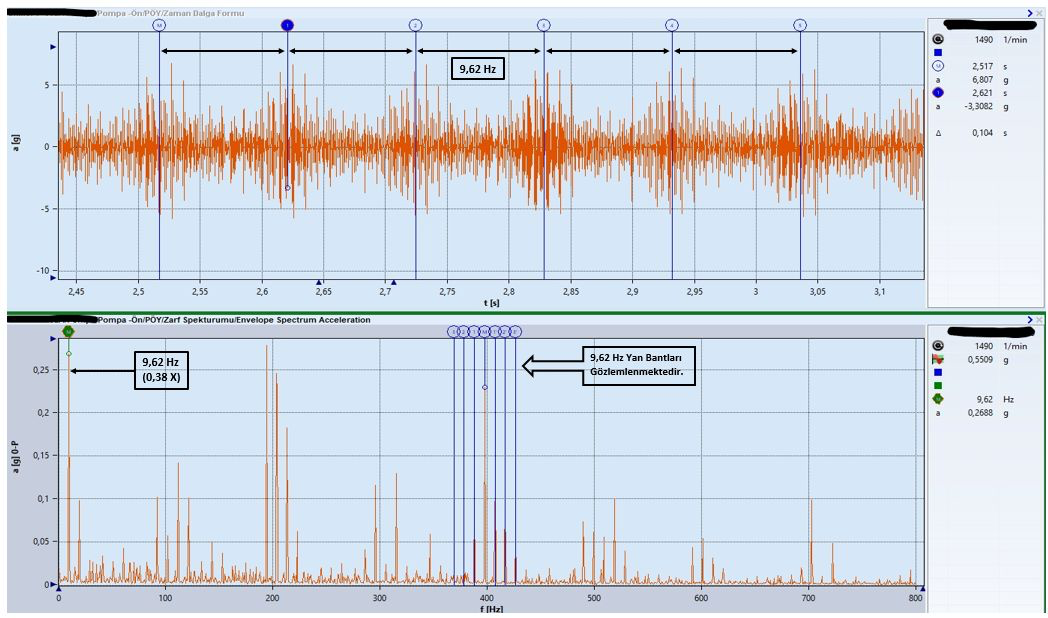
- A warning was observed in the front bearing housing acceleration value of the pump during the vibration measurement made on the chiller pump, which is connected to the electric motor operating at 1490 Rpm Start-Stop.
- When the spectrums are examined; The vibration levels of bearing failure and the amplitudes of the impacts it creates in the acceleration time waveform are seen at a high rate. Therefore; It was thought that the bearing coded 6313 had vibration at the cage failure frequency (FTF).
-However, it is thought that the pump leaks water into the bearing housing and the water causes deterioration in the oil film of the bearing, so the bearing locks and breaks.
- The situation that is thought to be the root cause of this case is that it is caused by cavitation. With the effect of the impacts caused by this problem, the seal and mechanical seal are damaged. As a result, water seeps into the bearing housing.
- Since chiller pumps operate in a closed system cycle, they have suction pressure, unlike tower pumps that are open to the atmosphere. Although this pressure factor is a factor that prevents cavitation; Cavitation problems are observed due to many errors such as inappropriateness of the discharge line, collector contamination status, blockage of the suction line filter, incorrect calculation of net positive suction pressure or pump material quality.
Additional Images