Understanding Beat Pattern in Signals
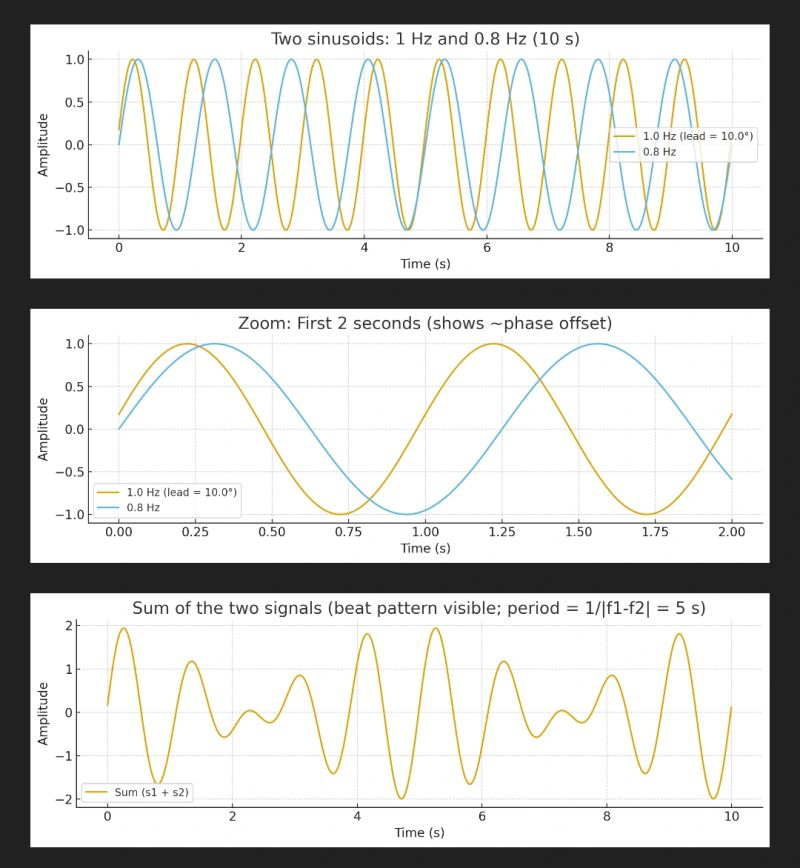
Two sine waves, 1 Hz and 0.8 Hz, create a beat pattern due to their close frequencies. This interaction produces sum and difference frequencies, with the beat frequency indicating one beat every 5 seconds.
Understanding Beat Pattern in Signals
In this demo, two sine waves — 1 Hz and 0.8 Hz — are combined, with the 1 Hz wave leading by 10°.
📈 Because their frequencies are close, the waves move in and out of phase over time.
When they align(In Phase), amplitudes add up (combined peak); when opposite(180° out of phase), they cancel (difference peak) — forming the beat pattern seen in the waveform.
🧠 This interaction produces two key frequency components:
Sum frequency: 1 + 0.8 = 1.8 Hz
Difference (beat) frequency: |1 – 0.8| = 0.2 Hz → one beat every 5 seconds
💡 In vibration analysis, such beats often appear when two sources rotate at nearly similar speeds or under resonance conditions.