Gypsum Crusher Bearing Fault with Normal Velocity Spectra
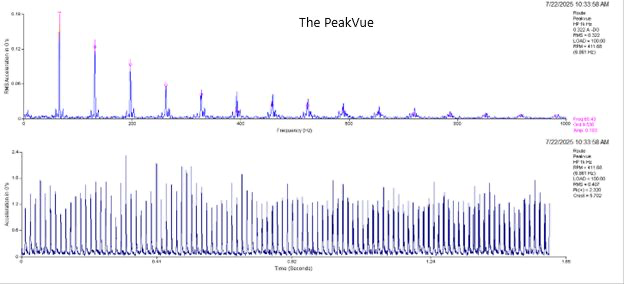
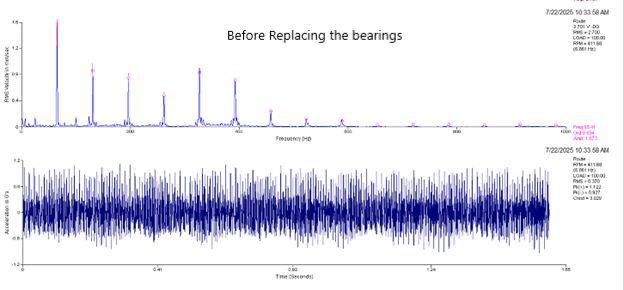
Normal velocity spectra are crucial for monitoring bearing conditions, especially for detecting defects in the final failure stages. A case study of a gypsum crusher bearing demonstrated that a dominant frequency at 65.4 Hz, corresponding to the 1X BPFI, indicated a bearing defect despite low G-level and PK+ values.
Don’t rely solely on PeakVue when monitoring bearing condition — normal velocity spectra play a critical role, especially in identifying defects at the final stages of failure.
In the case of the gypsum crusher bearing, the dominant frequency in the normal velocity spectrum was observed at 65.4 Hz, corresponding to the 1X BPFI (Ball Pass Frequency of Inner race). This frequency was accompanied by several harmonics, which is a strong indication of a bearing defect.
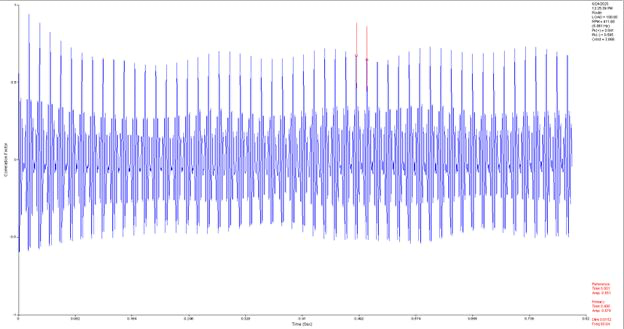
The time waveform autocorrelation also revealed impacts related to the BPFI, further confirming the presence of the defect.
It can be misleading to conclude that the bearing is still in good condition simply because the G-level remains low and PK+ has not reached a critical level. In this case, the normal velocity spectra clearly showed the bearing condition had deteriorated, and bearing replacement was strongly recommended.
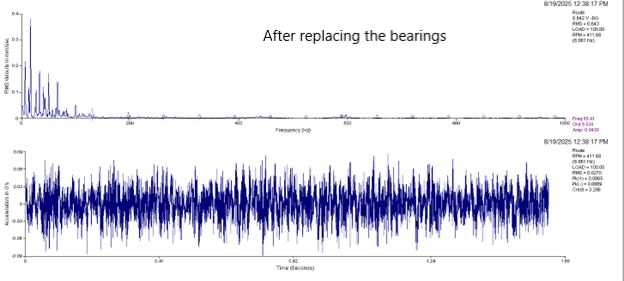
After replacing the bearings, the fault frequency disappeared, and the normal velocity spectra returned to a healthy state.
Important note: once a bearing fault frequency appears in the normal velocity spectra, it indicates that the defect has progressed from the subsurface crack phase to the failure phase. At this stage, it is highly recommended to replace the bearing at the nearest opportunity.
Additional Images