Rotating Stall in Pumps
Rotating stall in pumps, a common problem causing high vibration and noise, occurs when fluid flow deviates from its design direction, leading to flow separation and recirculation. Factors like improper design, incorrect operating conditions, and deteriorated components contribute to rotating stall.
Rotating stall in pumps
Rotating stall is one of the most common problems in pumps which excite high vibration and noise and anticipate pump failure.
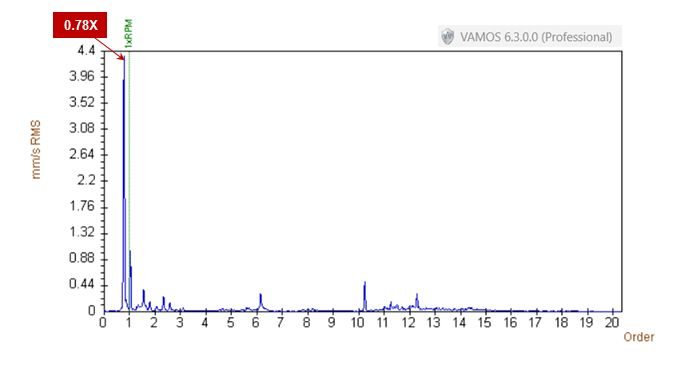
When a pump (or a compressor) is operated away from its design point, the fluid flow into the internal components (impellers, blades, diffusers, etc.) deviates from its design direction. If the angle of deviation (or incidence angle) is large, flow separation occurs. This flow separation results in recirculation of the fluid. The stall regions usually travel in the direction of the rotation at a speed that is fractionally lower than the rotating speed. The frequency of the excited vibration ranges from 60% to 93% of the operating speed.
Factors that affect rotating stall:
1. Improper design.
2. Incorrect operating conditions such as low flow rate or high discharge pressure.
3. Incorrect discharge valve opening.
4. Deteriorated internal components such as wear rings and impellers.
The plot below (from one of our clients in Basra) shows the FFT spectrum of a pump experiencing high vibration at 78% of the running speed due to rotating stall. The problem was partially solved by increasing discharge valve opening and finally by overhauling the pump.