Failure Analysis – Bearing 23076 CCK/C3W33 SKF – Right Bearing Housing – Deflection Drum 03
A spherical roller bearing (23076 CCK/C3W33 SKF) in the primary crusher showed excessive axial vibration (24.21 mm/s), poor lubrication, and faceted rolling elements due to loss of spin and excessive clearance, requiring immediate replacement and stricter adherence to lubrication and assembly procedures.
Report ID: TR_1210CC_02 – Primary Crusher CE 01
Report No.: 202501048321 – Planned Intervention: 02/10/2025
Prepared by: Wanderson Alencar & Jeison Felix
CMA Local Unit: Itabira Plant
Date: October 6, 2025
⸻
Objective of Inspection
1. Identify the root cause, bearing damage, and failure mode (ISO 15243:2004).
2. Improve the CMA/Predictive team’s understanding of failure modes, spectral vibration patterns, and anomaly progression.
3. Gather lessons and recommendations to prevent future rework.
⸻
Bearing Details
• Type: Spherical roller bearing
• Bore: Tapered
• Inner Diameter: 380 mm
• Outer Diameter: 560 mm
• Width: 135 mm
• Material: Alloy steel
• Rows: Double row
• Clearance class: C3
• Cage: Steel
• Load type: Radial
• Lubrication: With lubrication hole
• Shield: None
• Model: 23076 CCK/C3W33 SKF
⸻
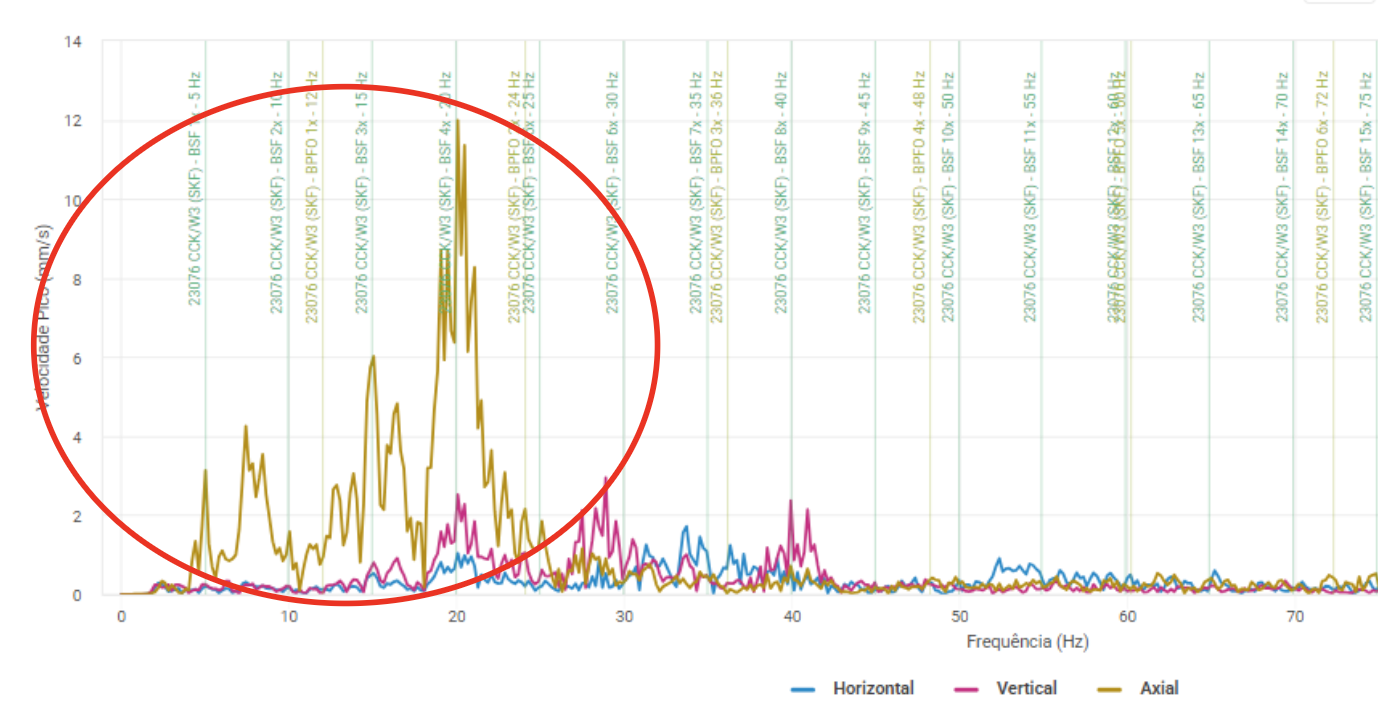
Spectral Analysis – Velocity Trend (mm/s)
The right-side bearing (Deflection Drum 03) entered A2 – Danger operational status due to a significant increase in vibration levels, especially in the axial direction.
• Measured vibration: 24.21 mm/s, exceeding recommended limits.
• Indicates risk of severe failure and potential process interruptions.
Further analysis showed:
• Raised noise floor (“carpet”), suggesting poor lubrication.
• Deterministic fault frequencies consistent with rolling element (BSF) defects.
• Signs of progressive wear, requiring immediate preventive action.
⸻
Failure Analysis – Rolling Elements (BSF)
1. Severe axial displacement of rolling elements on the outer race.
2. Inefficient lubrication.
3. Stage 3: Surface polishing/waviness developed.
⸻
Visual Findings
Rolling elements are faceted and have lost their spin capability.
Due to excessive internal clearance:
• The elements no longer contact the inner and outer races properly.
• In high-load regions, they slide instead of rolling, causing accelerated wear.
• This sliding motion removes lubricant, increases friction and heat, and accelerates surface damage.
The faceting observed is a direct result of this progressive clearance and inadequate lubrication, ultimately compromising bearing lifespan.
⸻
Recommendations
1. Assemble components strictly following the technical procedure.
2. Ensure lubricant type and schedule comply with the project’s specifications.