Ultrasound Analysis for Low-Speed Bearing Diagnostics - Listen Yourself
Ultrasound analysis of a low-speed bearing reveals periodic high-amplitude pulses and irregular spikes, suggesting a potential inner race defect. Regular ultrasound monitoring is recommended, along with further analysis to confirm the failure mode. Listen the Audio File Uploaded
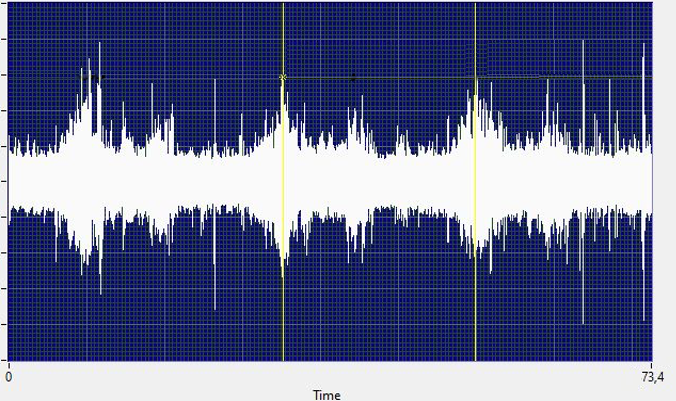
The uploaded waveform corresponds to an ultrasound recording acquired from a bearing operating at low rotational speed. Analysis of the time-domain signal reveals distinct high-amplitude pulse events, which occur periodically and exhibit harmonic spacing around 0.41 Hz. This periodicity correlates with an estimated shaft rotation speed of approximately 2.4 RPM, strongly indicating a potential inner race defect—a common fault mechanism in rolling element bearings.
In addition to the harmonically related pulses, the signal also contains irregular transient spikes that do not align with the fundamental or harmonic structure. While these anomalies may arise due to operational influences (e.g., variable loading, environmental noise), they can also point to incipient damage or contamination within the bearing.
Given the ultra-low RPM of the asset, ultrasound technology proves to be a highly effective condition monitoring technique, offering improved sensitivity over traditional vibration analysis for such slow-speed applications. It enables early detection of fault signatures that may not be visible using conventional accelerometers or spectral techniques.
📌 Recommendation: Regular ultrasound monitoring and trending of this bearing is advised. A more detailed fault frequency analysis and envelope demodulation may further confirm the failure mode and help distinguish between structural defects and random noise.