Condition Monitoring Management
Condition monitoring program management requires significant effort before launch, including criticality analysis, failure mode identification, technology selection, staffing, and integration with other departments. Once needs are identified, the program can be built, including equipment database creation, measurement parameter definition, and alarm and route setup.
𝗖𝗢𝗡𝗗𝗜𝗧𝗜𝗢𝗡 𝗠𝗢𝗡𝗜𝗧𝗢𝗥𝗜𝗡𝗚 𝗠𝗔𝗡𝗔𝗚𝗘𝗠𝗘𝗡𝗧
Managing a condition monitoring program is not simply ‘Plug and Play’. In addition to the ongoing management, there is a considerable amount of effort to be invested prior to launch. Some things to consider are:
• Performing a criticality analysis to identify which assets should be monitored, where they should be monitored (data collection points/positions) and how often,
• Distinguishing the failure modes and symptoms of each asset,
• Recognizing which CM technologies best identify those symptoms (preferable as early as possible),
• Staffing for data collection, analysis and interpretation and
• Integration with other departments (maintenance, production, stores, supply, etc.)
Once the needs have been identified, only then can the process of building the program begin. Building the equipment database, defining measurement parameters, operational limits, alarms and routes.
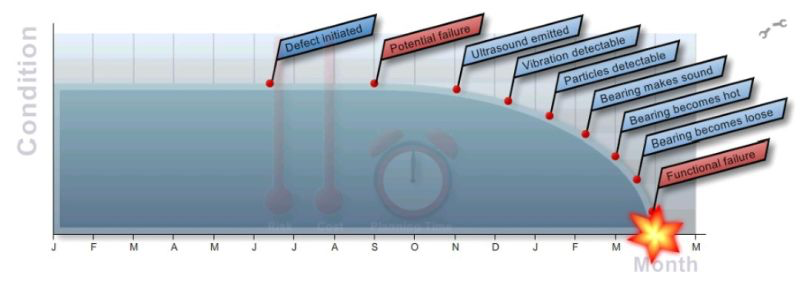
Fortunately, most failures provide a warning: ultrasound, vibration, temperature, particles in oil, change in current, and others. The time between the first warning signs and functional failure is the “P-F Interval” - Potential failure » Functional failure