Human Error in Maintenance
Human error, contributing to 20-30% of equipment failures, is a significant challenge in reliability and maintenance engineering. Addressing human error through proactive culture, training, and improved procedures is crucial for equipment performance and success.
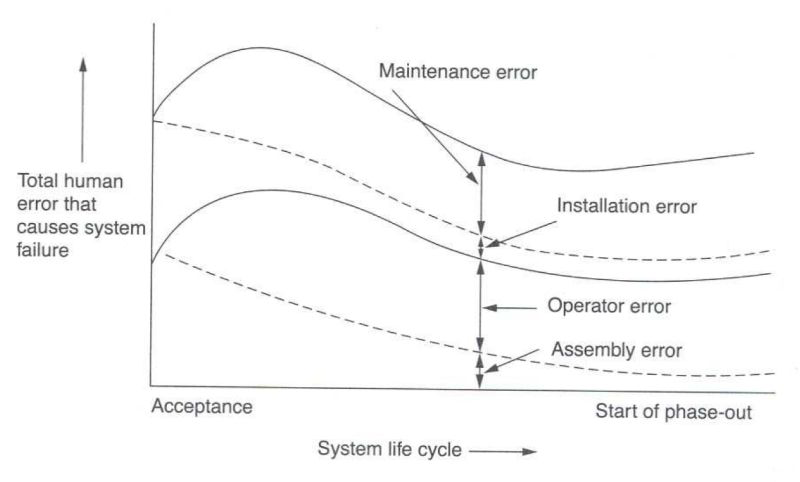
By definition, human error is the failure to perform a specified task that could lead to disruption of operations or damage to property and equipment. It can have significant safety, operational and negative financial implications. In the realm of reliability and maintenance engineering, addressing the cost of human errors is important. It has been an area of research interest dating as far back at the 1950's. To date, human error is still a prevalent challenge.
Dhillon & Singh stated that as much as 20% to 30% of all equipment failures are directly linked to human errors. In the attached figure, courtesy of Christensen & Howard, the approximate breakdown of human errors in a system life cycle is shown and it can be seen that:
1) Maintenance error's contribution to the total human error that causes system failure, is equal to that of operator error.
2) Moreover, as the system ages, maintenance errors increase dramatically.
Typical causes of human error include, but not only limited to:
1) reactive work environments
2) inadequate training
3) low inherent skill level
4) poor equipment design
5) improper work tools
6) poor motivation
7) poorly written maintenance and operating procedures
8) very low or very high stress levels.
We will look at the last point on stress in our next post.
While complete elimination of human error may not be feasible, but by shifting to a proactive culture, continuous improvement, training, design for maintainability, and high-quality maintenance and operating procedures you can significantly reduce human error occurrence and improve equipment performance. As we move forward in the ever-evolving industrial landscape, it's clear that human reliability is not a choice but a necessity for success.
At Tau SJV, our hashtag#ReliabilityEngineeringConsulting services can help with mitigating human error and assist clients through:
✅ shifting from reactive to proactive maintenance maturity
✅ maintenance planning and scheduling training
✅ development and improvement of preventive maintenance programs
✅ reliability modelling to optimise equipment design
✅ asset life cycle management
Sources:
1) Dhillon & Singh, Engineering Reliability,1978.
2) Christensen & Howard, Human Detection and Diagnosis of System Failures, 1981.