How slow can you go with Ultrasound
Ultrasound technology is effective for inspecting slow-speed bearings, even those turning at 1RPM or slower. A follow-up survey on 16 slow-speed bearings on a metal conveyor belt revealed deterioration in six bearings, despite consistent readings four months prior. The survey utilized a UE Systems Ultraprobe 15000 and DMS Software for analysis, employing audible quality, comparative analysis, historical trending, and software analysis to identify potential issues.
Observations on a slow speed bearing survey.
I keep getting questions on the effectiveness of ultrasound on slow speed bearings.
One of the advantages of Ultrasound is, that it keeps its effeteness even for ultra-slow bearings. I often do reports on bearings that turn at 1RPM or slower. We have also done successful work on slew bearings, that took 45 minutes to turn 260 degrees. So, my experience is that as long as there is movement and friction or potential for friction, it should work. As an example of the possibilities of using ultrasound on slow moving bearings I drafted this short observation abstract from one of the reports we did.
Outline
The brief was to do a follow-up survey on slow speed bearings (some only turning at 1RPM) on a metal conveyor belt, moving large rock fragments.
A total of 16 slow speed bearings were surveyed. Most of the readings were consistent with bearings in a good condition. Unfortunately, we did find 6 bearings of interest that showed deterioration from the previous survey.
The two different surveys were done only 4 months apart
The Methodology of the Inspection.
A UE Systems, Ultraprobe 15 000 was used to take the ultra sound readings.
The sound recordings were then entered into the UE Systems DMS Software and the recordings analyzed in the UE Systems Spectralisyer 4.2.6 software.
There are four different ways to analyze bearings with ultrasound technology:
1.1 Audible quality
Just by listening to the sound of a bearing, potential problems can be identified. To listen to the potential fault recordings, go to the UE Systems website (www.uesystems.com) where you can listen to sound file examples.
1.2 Comparative
Comparative analyses were done between similar bearings, and between the earlier readings and current readings.
Examples of the individual results of the bearings of interest will be discussed in the main part of this observation document.
1.3 Historical trending
We could do historical trending on the bearings on the conveyors as we had recordings taken four months earlier. We found deterioration of various levels in six of the 16 bearings we surveyed. I will show four in the document.
1.4 Analysis with software
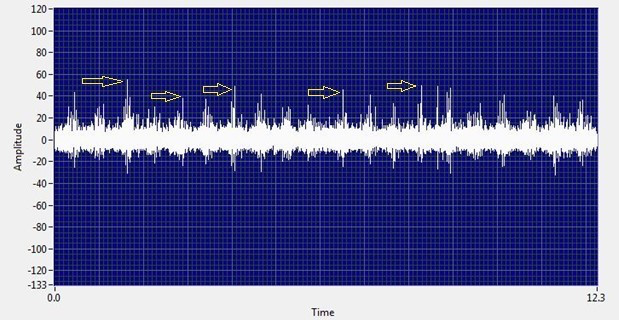
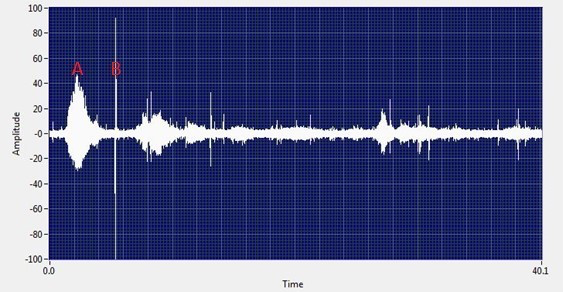
All the recorded sound files were analyzed in the UE Systems Spectralisyer Software. Several of the bearings showed Impacts on the Time Wave Form Graphs and further action was recommended.
Slow Speed Bearings
One of the big advantages of using Ultrasound on bearings, is that the speed of the bearing turning is not a limitation. We often do surveys on bearings moving at 1RPM, such as some of the bearings in this document. The slowest bearings we have done to date, was a slew bearing taking 45 minutes to turn 260 degrees in one direction.
My experience is that as long as there is movement with friction or potential for friction Ultrasound should work. There are a few conditions you need to consider e.g.:
· You may have to change the frequency to find the best recording. I have had to go down to between 20 and 25 kHz to get usable recordings on ultra-slow speed bearings.
· You need to record at least one complete full revolution. So, for a bearing that turns at 1RPM the recording needs to be at least 1 minute long.
· When you do ultra-slow speed slew bearings that turn in both directions you need to do recordings of the movement in both directions.
· Make sure there is the highest possibility for friction when you take the samples. For instance, there is a big difference in the potential for friction between loaded and empty conveyor belts.
· Always be on the lookout for competing ultrasound.
These are only some of the most obvious conditions and is not a full list.
I would be interested to hear from other Ultrasound technicians to add their experience regarding these points as well as additional points we can add to the list.
Competing ultrasound
As we were working on a metal conveyor belt (potential metal on metal friction of the belt moving) carrying large rock fragments (potential friction caused by rock fragments on moving conveyor belt) competing ultrasound was always going to be a possibility. So, to understand the potential for competing ultrasound caused by the metal conveyor belt, we took sound samples from the metal cage close to the metal conveyer belt, in between the bearings as a control recording.
Full Article can be found in the source link.
Additional Images