Lessons from Vibration Analysis
Vibration analysis reveals hidden stories within machines. Even minor vibration changes can indicate early-stage faults like misalignment or bearing wear—issues that, if caught early, prevent costly failures and secondary damage. Companies that invest in vibration monitoring programs gain higher uptime, safety, and savings through proactive maintenance and data-driven insights.
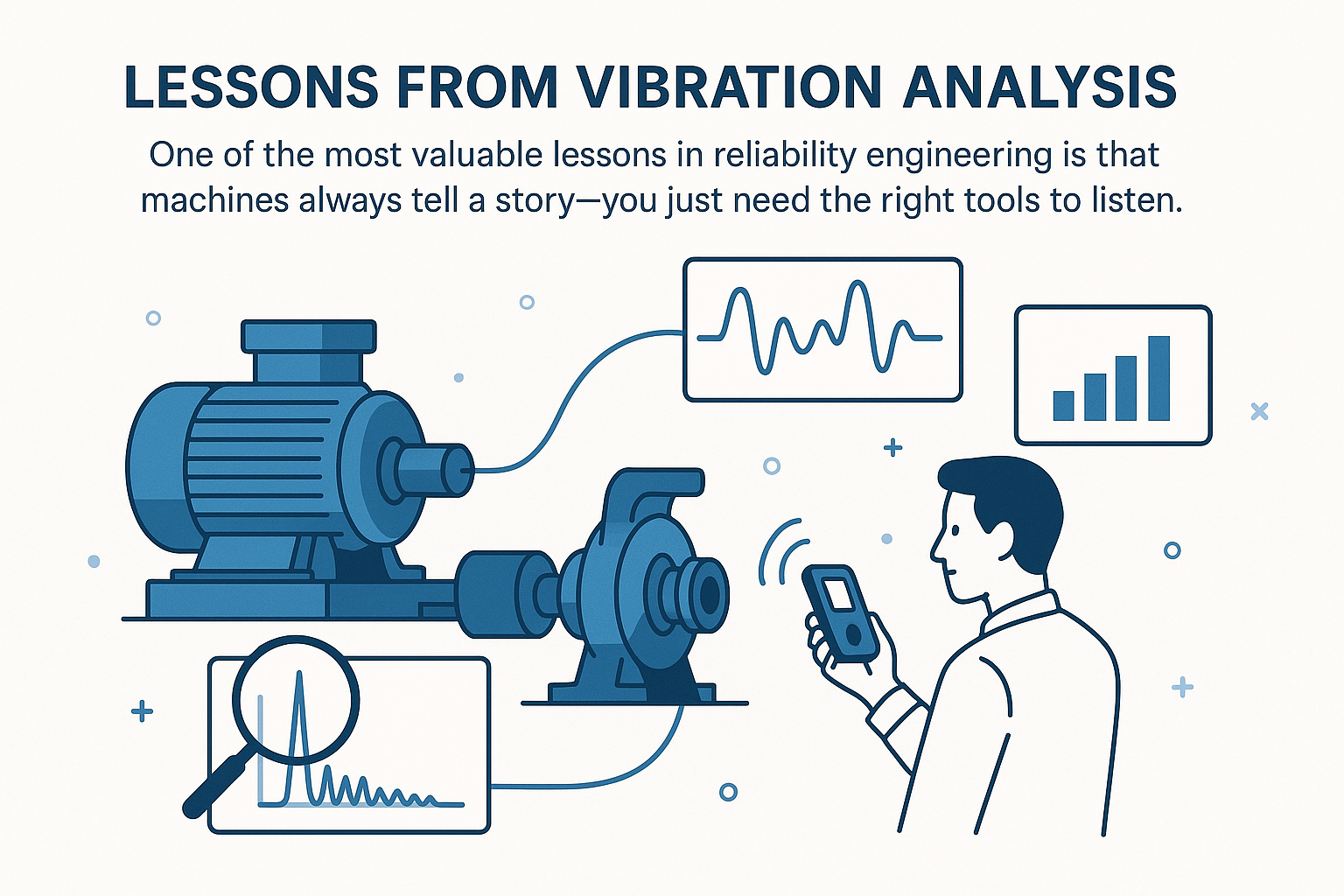
One of the most valuable lessons in reliability engineering is that machines always tell a story—you just need the right tools to listen. Vibration analysis is one of those tools that has saved countless companies from catastrophic failures. The beauty of it is that it can often detect problems at their very earliest stages, long before the human ear or eye could notice anything unusual.
For example, I once came across a case where a motor-driven pump showed only a slight increase in vibration amplitude at 1× RPM. To the untrained eye, it looked like “background noise.” But after further investigation, it turned out to be a classic sign of shaft misalignment. Left unchecked, that small misalignment would have escalated, putting additional stress on bearings and seals, leading to overheating, energy loss, and eventually complete failure of the pump. Because the issue was caught early, the team was able to realign the shaft during a scheduled stop. What could have become a $50,000+ failure ended up costing less than a few hours of planned maintenance.
This is the power of vibration analysis—it doesn’t just prevent breakdowns; it prevents secondary damage. A bearing defect, for instance, doesn’t only damage the bearing; it can destroy housings, rotors, couplings, and even foundations if allowed to progress. By reading the spectrum and time waveform data carefully, analysts can pick up on imbalance, looseness, misalignment, bearing wear, gear defects, and resonance issues—each of which has a unique vibration “fingerprint.”
Of course, not every company fully embraces vibration monitoring. Some see it as “extra work,” others rely only on simple threshold alarms, and a few don’t have trained analysts to interpret the data. But the organizations that do invest in vibration programs consistently see improvements in uptime, safety, and cost savings.
What’s the earliest-stage fault you’ve ever detected through vibration trends?