ML and DL for Identification of Faults in Bearings
Machine learning and deep learning are recommended for identifying faults in bearings, enhancing machinery lifespan, reducing maintenance costs, and improving production efficiency.
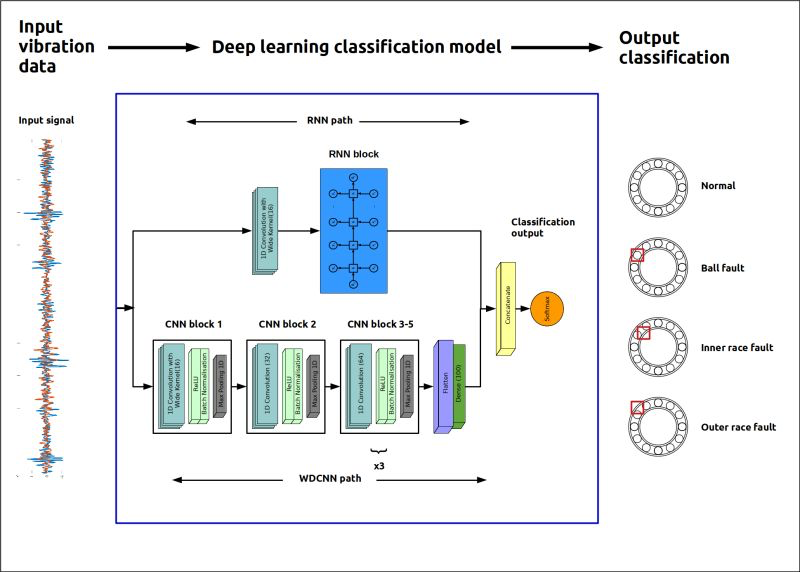
Evolution of Fault Detection: From Mechanical Techniques to Machine Learning 🦾
Bearing is one of the common causes which highly affect machine failure in various industries.
Navigating Unpredictable Faults in rotatory machinery: ⚙️
🧧 There are various types of damage, such as mechanical damage, crack, wear, lubricant deficiency, corrosion, etc. are possible faults.
🧧 There are other possible dents or manufacturing defects. Imbalance and misalignment can be determined through vibration.
🧧 These defects occur unpredictably, and it's very difficult to find all types of defects at an earlier stage, and the sudden defect causes heavy losses.
Identifying Faults in Bearings by Unleashing the Power of ML: 🔎
Several innovative techniques have been proposed for fault detection using vibration signals.
Some purely mechanical techniques used in the past include temperature monitoring, electric motor current monitoring, and vibration measurement.
Machine learning and deep learning are the most recommended ways to identify faults in bearing. Feature extraction techniques are applied to vibration data for machine learning models.
Results Obtained: 🎯
📌 Enhance the lifespan of the machinery.
📌 Efficient monitoring reduces the occurrence of large faults.
📌 Reduces the overall cost of maintenance and replacement.
📌 Enhances the production efficiency of the machinery.
📌 Ensures continuous working of the production.