Real-Time Anomaly Detection in Industrial Systems with Machine Learning
Real-time anomaly detection powered by machine learning identifies inefficiencies, leaks, or failures in industrial environments. It works by continuously streaming data, extracting features, training models on historical data, and alerting when anomalies are detected. This enables early fault identification, reduced downtime, and improved process safety.
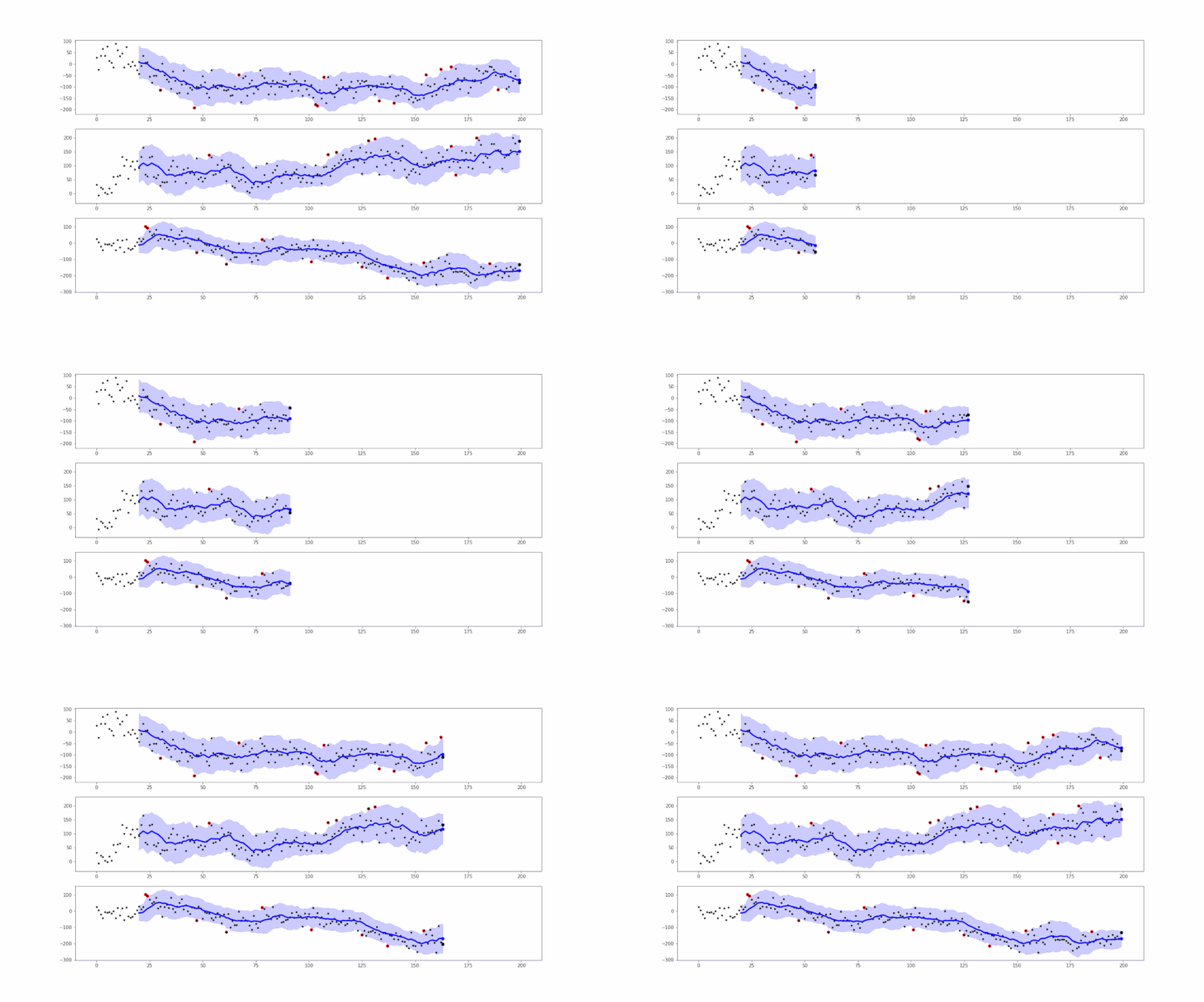
n complex industrial environments — from hydrogen plants to refineries, power generation, or chemical processing — every sensor reading tells a story. But hidden within those thousands of data points are early signs of inefficiencies, leaks, or failures that traditional monitoring might miss.
That’s where real-time anomaly detection powered by machine learning makes the difference.
🔍 How It Works:
1️⃣ Continuous Data Streaming – Process variables (pressure, temperature, flow, vibration, etc.) are captured in real time from DCS, SCADA, or IIoT platforms.
2️⃣ Feature Engineering – The system extracts rolling statistics, energy spectra, and correlations between process variables to represent normal behavior.
3️⃣ Model Training – ML algorithms learn from historical operational data to define what “normal” performance looks like for each equipment or process unit.
4️⃣ Detection & Alerting – When real-time data deviates beyond learned boundaries, the system flags anomalies instantly — enabling predictive maintenance and safer operations.
🤖 Best Models for Industrial Contexts:
✅ Isolation Forest – Highly effective for identifying abnormal sensor patterns in multidimensional datasets with minimal tuning.
✅ LSTM Autoencoders – Powerful for time-series prediction; detect gradual drifts or sudden deviations in dynamic process variables.
✅ Prophet + Residual ML Models – Useful for long-term trend and seasonality adjustments in production or energy data.
✅ Hybrid Statistical + ML Approaches – Combine domain knowledge (e.g., mass balance checks) with AI-based detection for interpretability and reliability.
⚡ Industrial Implementation Stack:
🔸 Data Pipeline: Kafka / MQTT / OPC-UA
🔸 Processing: Spark Streaming / AWS IoT Analytics
🔸 Model Serving: TensorFlow Serving / AWS SageMaker
🔸 Visualization: Grafana / PI Vision / Power BI
💡 Why It Matters:
Anomaly detection enables:
🔹 Early fault identification in compressors, pumps, and heat exchangers.
🔹 Real-time detection of leaks or process upsets in hydrogen or gas networks.
🔹 Reduced downtime and improved asset reliability.
🔹 Enhanced process safety and environmental compliance.
In a world moving toward autonomous, data-driven plants, real-time anomaly detection is becoming the digital nervous system of industrial operations.
🚀 The next frontier: integrating AI-based anomaly detection with digital twins for fully predictive process control.