High-Frequency Enveloping, Modulation, and Their Role in Vibration Analysis
High-frequency enveloping and modulation are advanced vibration analysis techniques used to detect machinery faults, particularly in bearings and gears. These methods isolate fault signatures from high-frequency vibrations, enabling the diagnosis of issues like bearing defects, gear tooth wear, and lubrication problems.
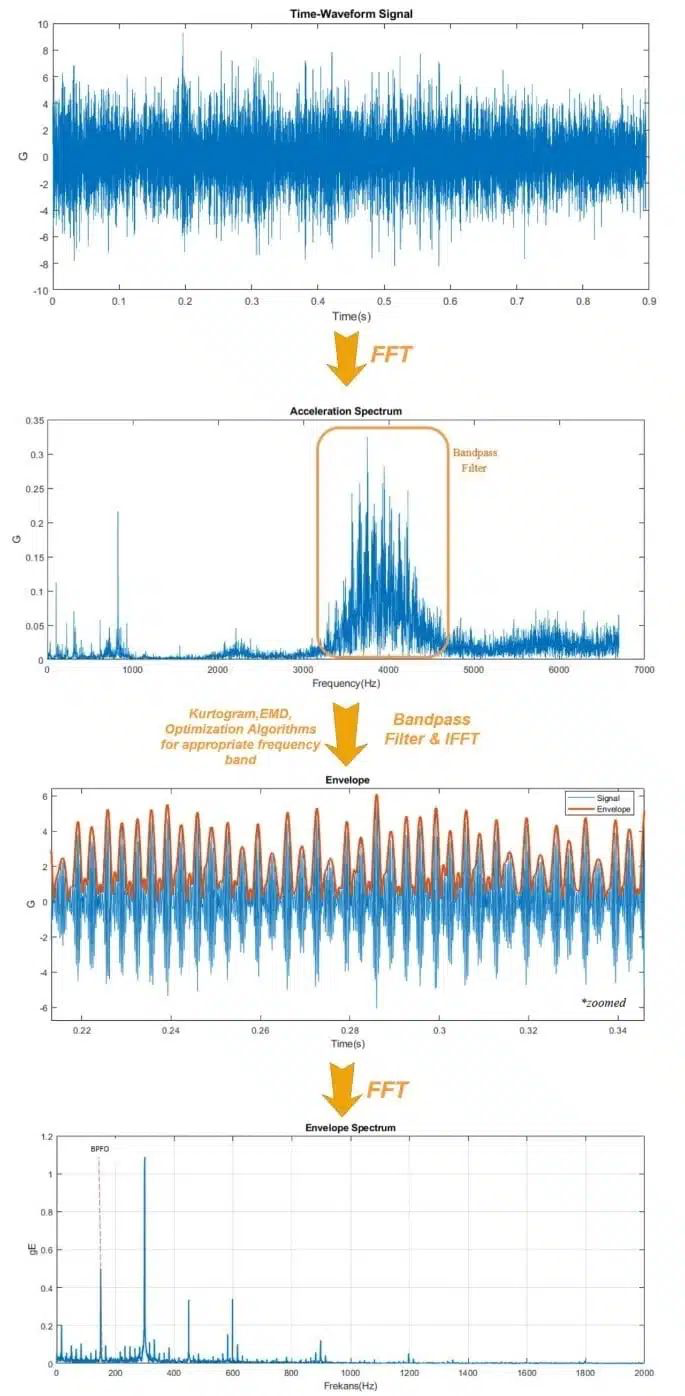
High-Frequency Enveloping, Modulation, and Their Role in Vibration Analysis:
High-frequency enveloping and modulation are advanced techniques in vibration analysis used to detect and diagnose faults in machinery, particularly in rolling element bearings, gears, and similar components. These methods help identify subtle fault signatures that might be masked by other vibration signals.
1. High-Frequency Vibration Analysis:
High-frequency vibrations occur in the ultrasonic range, typically above the audible frequency range (>20 kHz). These signals are often generated by:
Rolling element bearings under load.
Impacts from pitting, spalling, or cracking.
Gear tooth defects.
High-frequency analysis involves capturing these ultrasonic vibrations and interpreting them to diagnose faults.
2. Enveloping Technique:
Enveloping is a signal processing technique used to extract fault-related signatures from high-frequency vibration signals. It works by isolating the modulation pattern caused by impacts or irregularities in the system.
How Enveloping Works:
--Demodulation
--Filtering
--Rectification
--Envelope Detection
--Frequency Spectrum Analysis
The envelope is subjected to Fast Fourier Transform (FFT) to identify characteristic fault frequencies, such as:
Ball Pass Frequency Outer Race (BPFO)
Ball Pass Frequency Inner Race (BPFI)
Ball Spin Frequency (BSF)
Fundamental Train Frequency (FTF)
3. Modulation in Vibration Analysis:
Modulation refers to the alteration of a carrier signal's amplitude, frequency, or phase due to an underlying fault. In the context of vibration analysis:
Faults like bearing defects, gear tooth wear, or misalignment create periodic impacts or variations in force, which modulate the vibration signal.
Amplitude Modulation (AM) and Frequency Modulation (FM) are common in machinery diagnostics.
4. Applications of Enveloping and Modulation Analysis
--Bearing Fault Diagnosis:
Identifying characteristic frequencies like BPFO, BPFI, BSF, and FTF.
Gearbox Analysis:
Diagnosing gear tooth wear, cracks, or broken teeth.
Isolating gear mesh frequencies and their harmonics, modulated by defects.
Detection of Lubrication Issues:
High-frequency enveloping can reveal lubrication starvation or contamination in rolling element bearings.
Rotating Machinery Faults:
Detecting misalignment, imbalance, or looseness, especially when these faults cause modulated vibration patterns.