Calculation of Grease Applied in Bearings - Are You Doing It Right?
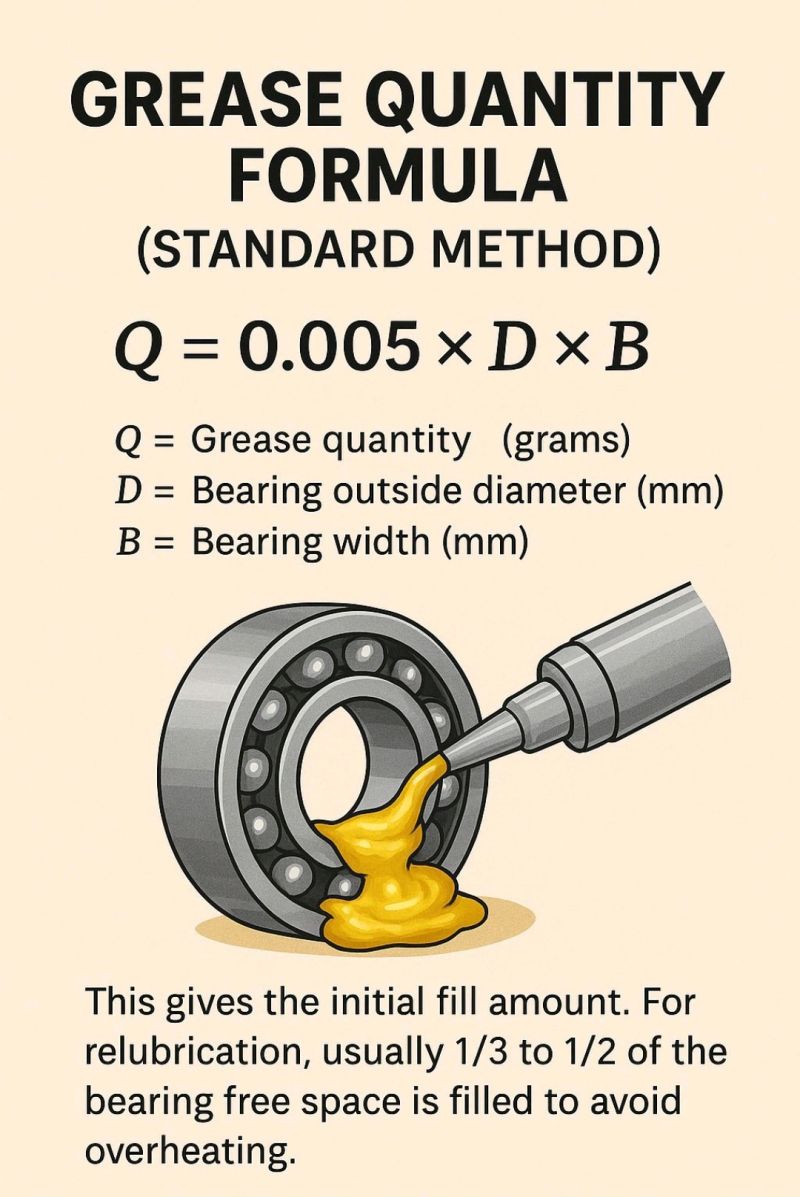
Proper lubrication of rolling element bearings is crucial for industrial maintenance. A formula (Grease (g)=DxB×0.005) helps calculate the right amount of grease, ensuring a balanced grease film and preventing damage.
Calculation of Grease Applied in Bearings - Are You Doing It Right?
In industrial maintenance, one of the most overlooked yet critical aspects is the proper lubrication of rolling element bearings.
Over-greasing or under-greasing can both be equally damaging, leading to premature failure, increased friction, and downtime. So how do you calculate the right amount of grease?
is: A widely accepted formula for initial grease quantity
Grease (g)=DxB×0.005
Where:
◆ D = Outer Diameter of the bearing (in mm)
B = Width of the bearing (in mm)
◆ 0.005 = Empirical constant (for standard applications)
Example:
For a bearing with D = 100 mm and B = 25 mm:
100×25×0.005=12.5grams
This formula helps ensure a balanced grease film without causing churning or heat build-up.
👉Initial fill = calculated value
👉Relubrication = only 1/3 to 1/2 of free space
👉Right lubrication = longer bearing life + smooth operations!
Tip: Always refer to the bearing manufacturer's specifications (SKF, FAG, NSK, etc.) and consider application-specific factors like speed (DN value), temperature, and environment.
Lubrication is not one-time-it's a strategy. Optimizing it can extend equipment life, boost efficiency, and save costs in the long run.
Let's grease it right, not just grease it more!?
by Muhammad Kamran Haider - LinkedIn